
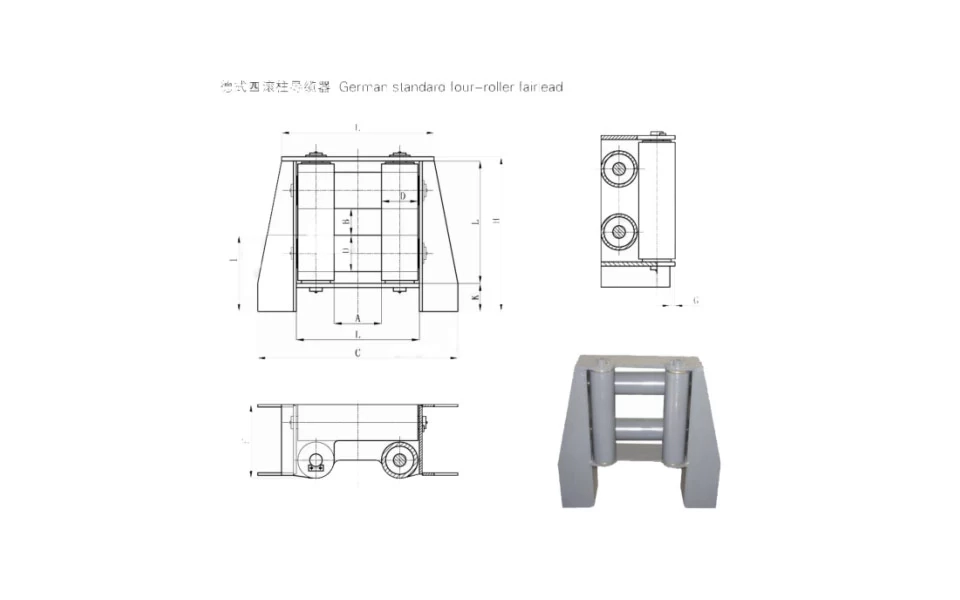
In modern marine engineering and offshore operations, controlled guidance of mooring lines is a fundamental requirement for maintaining vessel stability and ensuring safe handling under dynamic environmental conditions. Among the various types of line-handling equipment available, the German standard four-roller fairlead has become a widely adopted solution due to its structural reliability, smooth line guidance performance, and suitability for heavy-duty mooring applications.
Unlike simple fairleads that only guide rope direction, this four-roller configuration is engineered to reduce friction, distribute load more evenly, and improve the operational lifespan of mooring lines in demanding marine environments.
Engineering Concept Behind the Four-Roller Fairlead System
The German standard four-roller fairlead is designed based on controlled friction reduction and directional load management principles, allowing mooring lines or steel wires to pass through a guided path with minimal resistance and controlled deviation angles.
The structure typically consists of four strategically positioned rollers that work together to stabilize rope movement under tension, ensuring that the line remains aligned even when subjected to shifting vessel motion or changing environmental forces.
Key engineering characteristics include:
● Four-roller configuration that enables multi-directional line guidance under load
● Optimized roller spacing designed to reduce localized stress concentration on mooring lines
● High-strength frame structure engineered for offshore and port operation environments
● Smooth rotation system that minimizes friction during dynamic rope movement
● Structural compliance with German marine engineering standards for load reliability
These design elements make the system particularly suitable for applications where mooring lines are frequently exposed to variable tension and directional changes.
Functional Advantages in Mooring Line Management
One of the most important roles of a fairlead system is to ensure that mooring lines do not experience excessive wear or unpredictable movement during operation. The four-roller configuration improves this performance by distributing contact forces across multiple points rather than concentrating stress on a single surface.
This leads to more stable line behavior during docking, loading, and offshore positioning activities.
Operational advantages include:
● Reduced friction between mooring line and structural components during movement
● Improved load distribution that minimizes localized wear on ropes or steel wires
● Enhanced directional control of mooring lines during vessel movement
● Increased safety during high-tension mooring operations
● More consistent performance under varying sea and wind conditions
By improving how forces are transferred through the system, the fairlead contributes directly to safer and more efficient vessel handling.
Structural Design and Material Considerations
The durability and performance of a German standard four-roller fairlead depend heavily on its material selection and structural integrity. Since it is used in high-load marine environments, it must withstand both mechanical stress and long-term exposure to corrosive conditions.
Common material choices include:
● High-strength cast steel for heavy-duty offshore applications
● Welded structural steel for customized marine installations
● Surface-treated steel with anti-corrosion coatings for saltwater resistance
● Reinforced alloy components for improved fatigue resistance under cyclic loading
Structural design considerations include:
● Precision-aligned roller shafts to ensure smooth rotational performance
● Reinforced frame geometry to resist bending under high mooring tension
● Bearing systems designed to maintain low friction over long service cycles
● Protective surface treatment to extend operational lifespan in marine environments
● Standardized design compliance for integration with vessel mooring systems
These engineering choices ensure that the system remains reliable even under continuous operational stress.

Application Scenarios in Marine and Offshore Industry
The German standard four-roller fairlead is widely used across multiple maritime sectors where controlled rope handling and directional stability are required.
Commercial shipping operations
Large cargo vessels, tankers, and bulk carriers rely on fairlead systems to manage mooring lines during port docking and cargo handling operations, where precise line control is essential for vessel positioning.
Offshore engineering platforms
Oil platforms, floating production systems, and offshore wind installations require stable mooring line guidance systems that can handle continuous tension changes caused by waves and currents.
Port and harbor infrastructure
Docking facilities and terminal structures use roller fairleads to improve the efficiency and safety of vessel mooring operations, especially in high-traffic environments.
Specialized marine vessels
Tugboats, research vessels, and support ships benefit from enhanced line control systems that improve maneuverability and operational flexibility in complex marine environments.
Performance Behavior Under Dynamic Load Conditions
Unlike static marine components, fairlead systems must operate under continuously changing load conditions caused by vessel motion, wave impact, and wind forces. The four-roller configuration provides a controlled response mechanism that stabilizes line movement during these variations.
Observed performance characteristics include:
● Smooth transition of mooring lines under changing tension angles
● Reduced shock loading during sudden vessel movement or wave impact
● Stable rotational behavior of rollers under continuous operation
● Balanced force distribution that reduces system fatigue
● Predictable performance in both static and dynamic mooring conditions
These characteristics are particularly important in offshore environments where load conditions cannot be precisely controlled.
Importance of Standardization in Marine Equipment
The reference to German standard design reflects an emphasis on engineering consistency, structural reliability, and compatibility with international marine equipment systems. Standardization ensures that components can be integrated into different vessel configurations without compromising safety or performance.
Benefits of standardized design include:
● Easier integration into global vessel construction systems
● Improved reliability due to tested engineering specifications
● Consistent performance across different operational environments
● Simplified maintenance and replacement procedures
● Compatibility with a wide range of mooring line types and diameters
Standardization plays a critical role in ensuring predictable behavior in complex marine systems.
System-Level Role in Mooring Architecture
A four-roller fairlead does not operate in isolation but functions as part of a larger mooring system that includes winches, chains, ropes, and anchoring components. Its role is to act as a controlled interface between vessel structure and external load forces.
System-level functions include:
● Guiding mooring lines into correct load paths
● Reducing structural stress on vessel hull contact points
● Supporting coordinated operation with winch and tension systems
● Enhancing overall mooring system stability and safety
● Improving operational efficiency during docking and departure procedures
By acting as a controlled transition point, it helps maintain balance across the entire mooring system.
Company Introduction: WAC
Qingdao Wancheng Anchor Chain Co., Ltd. (WAC), established in 2006, is a professional manufacturer specializing in marine anchor chains and mooring equipment. The company produces a wide range of products from 16mm to 122mm and is certified by major classification societies including ABS, LR, and BV.
WAC products are widely used in shipbuilding, offshore engineering, and deep-sea aquaculture systems. With advanced manufacturing capabilities and strict quality control processes, the company provides reliable marine and mooring solutions for global industrial clients.
Conclusion
The German standard four-roller fairlead is a critical component in modern mooring systems, designed to ensure controlled line guidance, reduced friction, and stable load distribution under dynamic marine conditions. Its engineered structure, multi-roller configuration, and standardized design make it highly suitable for commercial shipping, offshore engineering, and port operations where safety and efficiency are essential.
For marine operators and engineering procurement teams, selecting a properly designed fairlead system is an important step toward improving operational reliability and reducing long-term equipment wear.
FAQ
Q1: What is the main function of a four-roller fairlead?
It guides mooring lines safely while reducing friction and distributing load more evenly during vessel operations.
Q2: Why is it called German standard fairlead?
It refers to a standardized engineering design approach that emphasizes structural reliability and consistent performance in marine applications.
Q3: Where is a four-roller fairlead commonly used?
It is widely used in commercial shipping, offshore platforms, harbor terminals, and specialized marine vessels.
Q4: What materials are typically used in its construction?
Common materials include cast steel, welded steel structures, and corrosion-resistant treated alloys designed for marine environments.

 English
 Chinese
 Spanish
 Arabic
 Japanese
 Korean
 Russian
 Portuguese