
A Panama Chock Type BC 310-500 is one component in a ship’s mooring arrangement, but its role becomes especially clear during berthing and departure. As mooring lines are paid out, transferred ashore, tensioned, and secured, they must pass through designated guiding points while the crew coordinates several pieces of deck equipment.
Mooring efficiency is not simply about completing these operations quickly. It also depends on whether the equipment arrangement allows the crew to handle lines in a controlled, predictable manner without unnecessary interference or repeated adjustments.
Although a mooring chock does not generate pulling force or control line tension independently, it provides an important connection between the vessel’s onboard mooring equipment and the shore-based securing points. Understanding this role helps explain why the coordination of individual deck fittings matters during everyday vessel operations.
Where Does Panama Chock Type BC 310-500 Fit into the Mooring Process?
During a typical berthing operation, the crew prepares the mooring lines and associated deck equipment before the vessel reaches its final position. Lines are then transferred ashore, placed on designated securing points, and adjusted according to the vessel’s mooring plan.
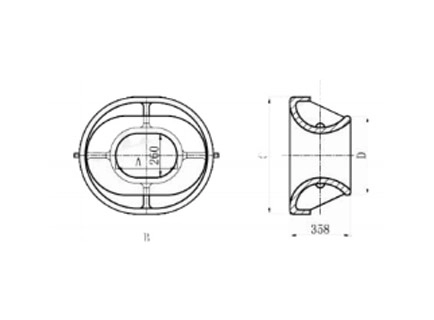
A Panama Chock Type BC 310-500 provides a designated passage for a mooring line as it travels between the ship and shore. Depending on the vessel’s arrangement, the line may be handled by a mooring winch and secured through the relevant onboard equipment.
The chock does not replace the functions of a winch, brake, or bollard. Instead, it guides the line through the vessel’s boundary and transfers the resulting contact forces into the supporting structure.
This distinction is important because successful mooring depends on several components performing different tasks together.
For example, a winch may be responsible for line handling and tension adjustment, while a bollard provides a securing point. The chock establishes the intended passage between the onboard arrangement and the external mooring point.
When these components are properly coordinated, the line can follow the planned route without unnecessary contact with unrelated deck structures.
Mooring Efficiency Begins Before the First Line Is Sent Ashore
Many difficulties encountered during mooring operations originate before the actual line-handling process begins.
If equipment is poorly arranged, the crew may have to work around obstructions, manage crossing lines, or deal with limited access to operating positions. These conditions can complicate an otherwise routine operation.Effective preparation therefore involves more than checking that individual components are present and functional.
The crew must understand which lines will be used, where they will be led, and how the equipment will be operated according to the vessel’s approved procedures.
Three aspects are particularly relevant.
Clear line routes. Each mooring line should follow its intended route through the designated equipment, avoiding unnecessary interference with adjacent fittings.
Accessible operating positions. The arrangement should allow personnel to operate the required equipment from appropriate locations while observing established safety procedures.
Coordination between equipment. Chocks, winches, bollards, and other fittings should function as parts of the same mooring arrangement rather than as isolated components.
A suitable Panama Chock Type BC 310-500 contributes to this arrangement by providing the specified line passage. However, the overall operational result depends on the complete system and the crew’s procedures.
What Happens During Line Handling?
The function of a mooring chock becomes easier to understand by following the line through the main stages of a berthing operation.
| Mooring stage | Main activity | Role of the chock |
|---|---|---|
| Preparation | Check lines and prepare deck equipment | Provides the designated line passage |
| Sending lines ashore | Transfer mooring lines to shore personnel | Guides the line through the ship’s boundary |
| Taking up slack | Adjust line length using the appropriate equipment | Maintains the intended guiding path |
| Securing | Establish the required mooring arrangement | Transfers line contact forces into the supporting structure |
| Monitoring | Observe and adjust the mooring arrangement as required | Continues to guide the line under changing conditions |
During these stages, the chock remains a passive component. It does not determine the correct line tension or automatically compensate for vessel movement.
Nevertheless, its position and compatibility with the intended arrangement are important because the mooring line continues to interact with the chock throughout the operation.
The objective is to support a controlled line path while the crew manages the operational requirements through the appropriate equipment and procedures.

Why Equipment Coordination Matters More Than Individual Components
A ship may be fitted with suitable mooring equipment, yet still experience operational difficulties if the components are not coordinated within the overall arrangement.
Consider a mooring station equipped with a winch, a bollard, and a chock. Each component may meet its individual specifications, but the line must still travel between them in a way that is compatible with the vessel’s design.
If the equipment arrangement creates unnecessary obstructions or difficult handling conditions, the crew may face additional operational challenges.
This does not necessarily indicate that the chock itself is defective. The underlying issue may involve the interaction between several fittings.
Coordination with mooring winches
The winch handles the mooring line according to the vessel’s operating procedures. The line passage through the chock should be compatible with the intended winch arrangement and the relevant design requirements.
Coordination with bollards
Bollards and other securing fittings provide designated locations for holding mooring lines. The chock must be considered in relation to these points so that the intended line route remains practical.
Coordination with surrounding deck equipment
Other fittings, structural members, and operating areas can influence the accessibility of a mooring station. The arrangement should avoid unnecessary interference while maintaining the required structural and operational clearances.
These relationships demonstrate why the performance of a mooring station cannot be evaluated solely by examining one component.
The Difference Between Faster Mooring and Better Mooring
It is easy to associate efficiency with shorter berthing times, but speed alone is not a reliable measure of mooring performance.
Mooring operations involve substantial forces and changing vessel conditions. Rushing line handling or attempting to reduce the number of necessary checks can increase operational risk.
A more useful understanding of efficiency focuses on reducing avoidable complications while maintaining established safety requirements.
For example, an effective mooring arrangement should support:
- Clear identification of the intended line routes
- Predictable interaction between lines and deck fittings
- Practical access to designated operating positions
- Inspection and maintenance of relevant equipment
- Consistent execution of approved mooring procedures
A Panama Chock Type BC 310-500 can contribute to these objectives when it is appropriately specified and integrated into the vessel’s arrangement.
However, no individual chock model can guarantee faster berthing, lower crew workload, or improved safety outcomes without considering the wider operational context.
How Does the Chock Remain Relevant After Berthing?
The role of a mooring chock does not end once the lines have been secured.
While a vessel remains alongside, changes in tide, draft, environmental conditions, and vessel position may affect the mooring arrangement. The crew may need to monitor line conditions and make adjustments according to established procedures.
Throughout this period, the chock continues to provide the designated guiding passage for the mooring line.
Its condition also becomes relevant during routine inspection. Visible damage, corrosion, or deterioration affecting the intended contact surfaces should be assessed in accordance with the vessel’s maintenance requirements.
Before departure, the crew prepares to release the mooring lines in the required sequence. The same equipment arrangement is then used as lines are recovered and secured onboard.
This repeated use during berthing, alongside operations, and departure explains why mooring chocks are important elements of a vessel’s everyday deck equipment.
Panama Chock Type BC 310-500 in a Complete Marine Equipment Arrangement
Qingdao Wancheng Anchor Chain Co., Ltd. supplies Panama Chock Type BC 310-500 as part of its ship outfitting and marine equipment range.
For shipbuilding and marine engineering projects, mooring chocks are generally considered together with related equipment rather than as completely independent items.
Wancheng’s product range also includes other mooring chocks, bollards, guide rollers, and marine fittings that may form part of a vessel’s deck equipment arrangement.
When confirming a Panama Chock Type BC 310-500 configuration, relevant information includes the required product specification, mooring arrangement drawing, intended line characteristics, applicable design loads, and installation requirements.
These details provide a basis for discussing product matching, drawing coordination, and related marine equipment configurations.
Wancheng can support technical communication concerning its available product specifications and associated ship outfitting requirements. Product-specific ratings, dimensions, and documentation should be verified against the applicable drawings and project requirements.
Conclusion
A Panama Chock Type BC 310-500 supports ship mooring operations by providing a designated passage for mooring lines and connecting the onboard equipment arrangement with external securing points.
Its contribution is most apparent when viewed across the complete operational sequence, from preparing and sending lines ashore to securing, monitoring, and eventually releasing them.
Efficient mooring depends on the coordination of equipment, personnel, and procedures. By integrating the appropriate chock configuration with the vessel’s wider mooring arrangement, shipbuilding and marine engineering teams can establish a more practical foundation for controlled and consistent mooring operations.
FAQ
1. What is the main function of Panama Chock Type BC 310-500 during mooring?
Its primary function is to provide a designated guiding passage for mooring lines between the vessel and external securing points. It also transfers the resulting line contact forces into the supporting ship structure.
2. Can Panama Chock Type BC 310-500 improve mooring efficiency?
It can support a practical mooring arrangement when correctly specified and integrated with other equipment. However, overall efficiency depends on vessel design, equipment coordination, crew procedures, and operating conditions rather than the chock alone.
3. Does Panama Chock Type BC 310-500 control mooring line tension?
No. A mooring chock is a passive guiding component. Line handling and tension management are performed through the appropriate mooring equipment and operating procedures.
4. What equipment is commonly considered alongside Panama Chock Type BC 310-500?
Related equipment may include mooring winches, bollards, fairleads, guide rollers, and other deck fittings. Their arrangement should be evaluated according to the vessel’s mooring design and applicable technical requirements.

 English
 Chinese
 Spanish
 Arabic
 Japanese
 Korean
 Russian
 Portuguese