
Marine aquaculture mooring systems are usually made up of anchors, mooring chains, ropes, shackles, and other connecting components. Compared with large anchors or long lengths of mooring chain, a shackle may look like a relatively small part, but it often sits at a critical point where load is transferred from one component to another.
The Aqua Moor Shackle 140 is designed for marine and aquaculture mooring connections where it may be exposed to waves, currents, cage movement, repeated loading, and long-term seawater conditions. In addition to load capacity, bolt retention, articulation space, load alignment, and clearance from nearby nets or ropes can all affect actual performance.
For this reason, confirming whether an Aqua Moor Shackle is suitable for a project should involve more than comparing tonnage. The shackle needs to be considered as part of the complete mooring system.
Why Is Connection Geometry Important for an Aqua Moor Shackle 140?
An Aqua Moor Shackle 140 is normally installed between two mooring components, such as a chain and another fitting, or between a rope termination and a mooring assembly. Load enters the shackle through one connection point and continues through the bow and bolt area into the next part of the system.
Ideally, the connected component should sit naturally within the intended bearing area and retain enough freedom to move as load direction changes. If the internal space is too limited, the fitting may bind against one side of the shackle. If the clearance is excessive, the connection may experience unnecessary movement and impact as loads fluctuate.
Several factors should therefore be considered together:
- Dimensions of the connected chain or fitting
- Effective internal clearance of the shackle
- Bolt dimensions and locking method
- Articulation space required during operation
- Main direction of the mooring load
- Position of nearby nets, ropes, and fittings
These factors determine whether the load can pass through the connection in the intended way.
Why Is a Recessed Bolt Useful in Aquaculture Mooring Systems?
Connections in offshore aquaculture systems are not completely static after installation. Cages continue to move under waves, currents, and tides, which means shackles experience repeated changes in load and slight relative movement.
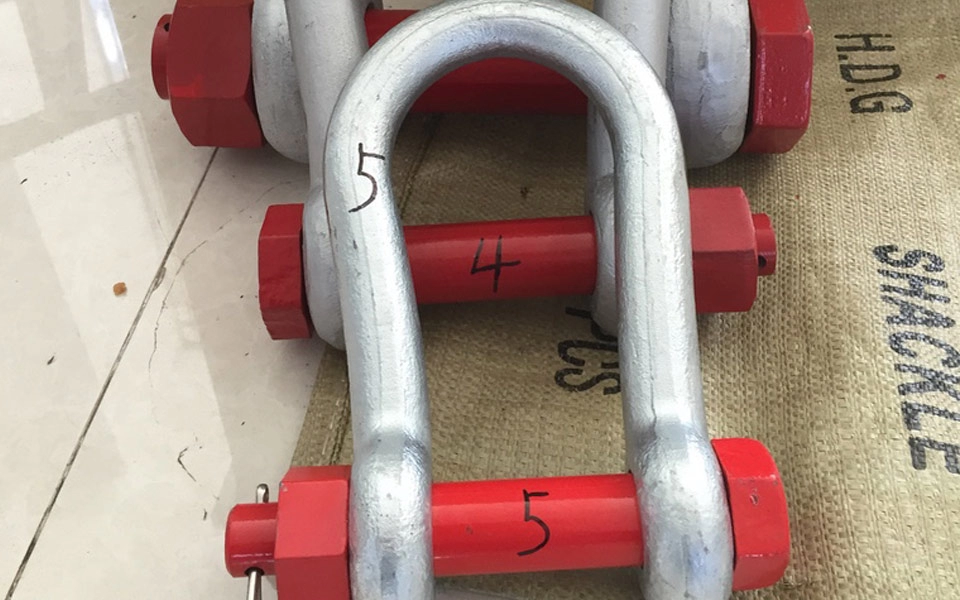
The Aqua Moor Shackle 140 uses a compact recessed-bolt design in which the bolt is locked into the shackle body. This arrangement offers two practical advantages for cage mooring systems.
First, concentrating the bolt within the shackle structure helps reduce the risk of unintended rotation during long-term cyclic movement. Second, reducing bolt projection lowers the possibility of contact with nearby nets, ropes, or other flexible structures.
The bolt design is therefore not only about closing the shackle. It also contributes to connection stability and clearance around surrounding structures.
Why Does Repeated Fatigue Loading Matter More Than a Single High Load?
One of the defining features of offshore mooring systems is that loading is repeated continuously.
Waves cause cages to move vertically, currents change the direction of force, while wind and tides keep the mooring system under dynamic conditions. A shackle may therefore experience a very large number of load cycles in addition to occasional higher loads.
This is different from carrying one high static load. Over long service periods, if force remains concentrated on one side of the shackle or if articulation is restricted, the same local area may repeatedly experience higher stress and become more susceptible to fatigue.
Long-term connection performance therefore depends on several conditions:
- Material and structure must suit the expected load
- Connected components should align naturally
- Internal movement should not be unnecessarily restricted
- The bolt area should remain stable
- Load should not remain concentrated on one side of the bow or bolt
Load rating is important, but the actual connection geometry determines how effectively that capacity is used.
What Wear Patterns May Indicate Poor Connection Matching?
An unsuitable shackle connection does not always show obvious damage immediately. In many cases, the first signs are localized wear, polishing, or unusual contact marks.
| Observation | Possible Issue |
|---|---|
| One side of the bow wears faster | Connected component is not naturally centered |
| Local wear near the bolt | Restricted articulation or off-center loading |
| Connected chain link binds inside the shackle | Opening or interface dimensions do not match |
| Shackle remains twisted under load | Mooring direction or connection geometry may be unsuitable |
| Nearby netting shows rubbing marks | Insufficient clearance around hardware |
These signs should not be treated as a complete diagnosis on their own, but they can help reveal where actual load and movement are occurring.
For example, if wear repeatedly develops on only one side, increasing the shackle size may not solve the problem. Connection dimensions, mooring direction, and the overall load path should also be checked.
Why Is a Larger Aqua Moor Shackle Not Always Better?
In marine mooring systems, it is easy to assume that a larger shackle provides a greater safety margin. However, increasing shackle size changes more than load capacity. Internal opening, bolt diameter, overall dimensions, and required installation space also increase.
Wancheng’s Aqua Moor Shackle 140 range includes 40T, 60T, 90T, and 150T versions. Different sizes should be matched to both the expected mooring load and the dimensions of the connected components.
If a shackle is significantly larger than the connected chain link, excessive movement may occur inside the bow. If the shackle is too small, normal articulation may be restricted. The suitable size should balance:
- Required load capacity
- Dimensions of connected chains or fittings
- Necessary articulation space
- Clearance from nearby nets and ropes
Tonnage is therefore only the first step in size confirmation.
What Information Helps Confirm the Right Aqua Moor Shackle 140?
When confirming an Aqua Moor Shackle for a project, complete connection information is more useful than simply stating the required tonnage.
Useful information includes:
- Expected mooring load or required load class
- Dimensions of connected chains, rope terminations, or fittings
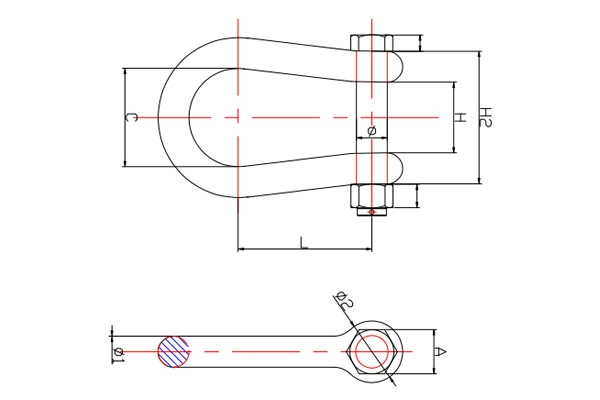
- Existing shackle drawings or measured dimensions
- Overall mooring layout or connection drawing
- Available clearance around nets and ropes
- Inspection or technical documentation requirements
For replacement projects, dimensions of the existing shackle are especially valuable. Even if two shackles have similar load ratings, their internal openings, bolt dimensions, and overall lengths may still differ.
Why Should the Shackle Be Considered as Part of the Complete Mooring System?
The Aqua Moor Shackle 140 is only one connection point within a complete mooring system. A typical aquaculture mooring arrangement may also include anchors, mooring chains, ropes, thimbles, and other connecting fittings.
The load path can be simplified as:
Anchor → Mooring Chain or Rope → Shackles and Connecting Fittings → Cage or Floating Structure
When each component is selected independently, problems often appear at the interfaces. A chain link may be too wide, the shackle may not provide enough internal clearance, a rope termination may have insufficient articulation space, or a fitting may sit too close to nearby netting.
The shackle should therefore do more than simply connect two components. It should allow load and movement to transfer smoothly between them.
What Aquaculture Mooring Support Can Wancheng Provide?
Qingdao Wancheng Anchor Chain Co., Ltd. supplies the Aqua Moor Shackle 140 together with anchors, mooring chains, shackles, thimbles, and related connection components for marine and aquaculture applications.
For new mooring systems or replacement projects, Wancheng can support product matching based on load class, chain dimensions, connection drawings, and available installation space. Drawing-based requirements, non-standard connection configurations, and related technical documentation can also be supported. This allows the Aqua Moor Shackle to be considered together with the anchor, mooring chain, and surrounding fittings rather than as an isolated product.
If project drawings, chain dimensions, or details of an existing connection are available, these can be used to compare load class, interface dimensions, articulation space, and surrounding structure. This helps confirm whether a 40T, 60T, 90T, or 150T configuration is more suitable and whether related fittings also need to be adjusted.
Conclusion
The actual performance of an Aqua Moor Shackle 140 cannot be determined by load rating alone. For long-term aquaculture mooring systems, four relationships are especially important:
Load capacity + Bolt retention + Connection dimensions + Articulation space
A recessed bolt helps keep the closure compact and reduces unnecessary contact with nearby netting, while suitable dimensions and articulation space allow connected components to align more naturally as marine loads change.
For new cage mooring systems, existing system replacements, or non-standard connection projects, confirming the load, chain dimensions, connection drawings, and installation space is more reliable than selecting a shackle based only on tonnage.
FAQ
What is an Aqua Moor Shackle 140 mainly used for?
It is mainly used in offshore aquaculture, fish-farm cages, and other marine mooring systems where it connects mooring chains, rope terminations, and related fittings under repeated marine loading.
Why does the Aqua Moor Shackle use a recessed bolt?
The recessed-bolt design helps reduce bolt projection and unintended rotation while lowering the risk of interference with nearby nets or ropes.
What sizes are available for the Aqua Moor Shackle 140?
Wancheng’s range includes 40T, 60T, 90T, and 150T versions for different load and connection requirements.
Can the correct shackle size be selected by load rating alone?
No. The dimensions of connected components, articulation space, actual load direction, and surrounding mooring arrangement should also be considered. For replacement projects, existing shackle drawings and interface dimensions are especially useful.

 English
 Chinese
 Spanish
 Arabic
 Japanese
 Korean
 Russian
 Portuguese