
When evaluating a marine anchor, weight is only one part of the decision. The anchor must also set quickly, remain stable in the intended seabed, match the existing anchor chain and windlass, and return smoothly to the hawse pipe or anchor pocket during recovery.
The AC-14 SB HHP Anchor 75KG-30000KG is a high holding power anchor designed to penetrate the seabed and use the resistance of the surrounding soil to hold the vessel. Compared with anchor types that rely more heavily on dead weight, the AC-14 SB places greater emphasis on fluke area, structural balance, and the direction in which the load reaches the anchor.
Its nominal weight range of 75kg to 30000kg covers a wide variety of vessels and marine structures. However, the correct specification cannot be determined only by vessel length or the weight of an existing anchor. The anchor, chain, windlass, hull structure, and operating environment must be considered as one complete system.
How Is the Weight of an AC-14 SB HHP Anchor 75KG-30000KG Determined?
The weight of an AC-14 SB HHP Anchor 75KG-30000KG should be confirmed from the vessel design, anchoring arrangement, and applicable classification requirements. Vessel length alone does not provide enough information.
Important factors normally include:
- Vessel displacement and principal dimensions
- Freeboard and projected wind area
- Vessel type and operating area
- Anchor chain diameter, grade, and length
- Windlass pulling and braking capacity
- Hawse pipe, anchor pocket, and deck equipment dimensions
- Required proof load and documentation
For a replacement project, the existing anchor type, nominal weight, connecting dimensions, and onboard stowage arrangement should also be checked. Even when two anchors have the same nominal weight, differences in crown width, shank length, or connection geometry may prevent the new anchor from fitting the existing hawse pipe or anchor pocket.
Anchor weight is therefore only one part of the specification. Complete drawings and system dimensions provide a more reliable basis for confirming the correct product.
Why Is High Holding Power Not Simply About Greater Weight?
Anchoring stability depends on whether the flukes can penetrate the seabed and mobilize enough soil resistance after the load is applied. Weight helps the anchor reach and contact the seabed, but the main holding force is created by the interaction between the anchor geometry and the seabed.
The AC-14 SB HHP Anchor has a relatively large working fluke area. When the anchor chain pulls the shank at a low angle, the flukes tend to move deeper into the seabed instead of dragging for a long distance along the surface. As penetration increases, the soil ahead of and around the flukes produces greater resistance.
HHP stands for High Holding Power. This designation is associated with an anchor design that has demonstrated higher holding performance than an ordinary stockless anchor of the same weight under the applicable approval and testing requirements.
The value of the design is therefore not that the anchor is simply heavier. It is that the geometry produces a more effective relationship between anchor mass and holding capacity.
In Which Seabeds Does the AC-14 SB Perform More Reliably?
No anchor develops exactly the same holding performance in every seabed. Soil strength, density, moisture content, and surface condition all influence how the flukes penetrate and hold.
Sandy Seabeds
Sand often provides suitable conditions for fluke penetration. Once the flukes reach sufficient depth, the sand in front of them can create stable resistance. Dense sand may require a longer dragging distance before the anchor sets, but it can provide strong resistance after proper penetration.
Clay Seabeds
Clay has cohesive properties and can develop high resistance after the flukes are fully embedded. Very hard clay may make initial penetration more difficult, while very soft clay may allow deep penetration without immediately providing strong holding performance.
Soft Mud
In soft mud, the anchor may sink easily, but the seabed itself may have limited strength. Penetration depth alone does not confirm that the anchor has set securely. Chain tension and vessel position should also be monitored.
Gravel or Hard Seabeds
Gravel, stones, rock, and seabed debris may prevent the flukes from penetrating correctly. The anchor may bounce, slide, or make only partial contact, so the setting condition requires careful confirmation.
The AC-14 SB structure supports rotation and penetration, but suitable chain scope, controlled initial loading, and an understanding of seabed conditions are equally important.

Why Does Anchor Chain Scope Affect Holding Performance?
The anchor chain does more than connect the vessel to the anchor. It also changes the angle at which the load reaches the anchor shank.
When sufficient chain is deployed and part of it remains on the seabed, the pull at the anchor is closer to horizontal. This condition helps the flukes continue moving downward into the soil.
When the deployed chain is too short, it lifts away from the seabed more quickly and creates a greater upward force on the anchor. The flukes may then begin to break out before sufficient holding resistance has developed.
The required chain scope depends on:
- Water depth
- Wind, wave, and current conditions
- Vessel wind area
- Chain weight per unit length
- Available anchoring space
- Expected load variation
A high holding power anchor cannot fully compensate for clearly insufficient chain scope. The anchor geometry and chain arrangement must work together.
Can an AC-14 SB Directly Replace Another Anchor Type?
A similar nominal weight does not automatically make two anchor types interchangeable.
Different anchor designs may have significantly different overall dimensions, centers of gravity, crown widths, shank lengths, and connecting arrangements. Before replacement, the following points should be checked:
- Nominal weight
- Overall length and width
- Crown and fluke dimensions
- Shank section
- Anchor shackle dimensions
- Hawse pipe and anchor pocket space
- Orientation during recovery
- Applicable rules and approval requirements
Even when the holding capacity is suitable, an anchor that is too large for the existing stowage arrangement may interfere with the hull or anchor pocket during recovery. Incorrect connection dimensions may also restrict movement between the chain and anchor.
Replacement should therefore be based on vessel drawings, original anchor information, and the dimensions of the complete anchoring system.
How Can You Tell Whether the Anchor Has Set Properly?
Reaching the seabed does not mean that the anchor has developed stable holding power. The more important question is whether it continues to drag after tension is applied to the chain.
Useful indications include:
- Chain tension increases steadily instead of repeatedly becoming slack
- The vessel position begins to stabilize
- The direction of the anchor chain stops changing continuously
- The chain remains steadily loaded when controlled astern power is applied
- Positioning equipment shows that the vessel is no longer moving outside the expected area
If the chain continues to shake, its direction keeps changing, or the vessel still moves noticeably astern, the flukes may not have penetrated fully. The seabed may also be unsuitable at the selected position.
Applying the load gradually usually gives the flukes a better opportunity to penetrate than applying a sudden high load immediately after deployment.
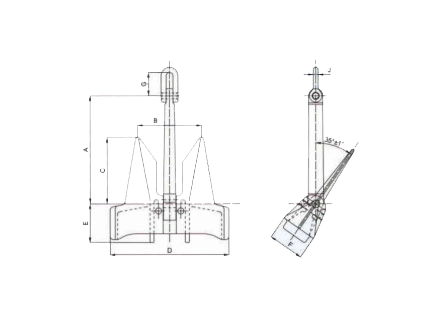
Recovery and Stowage Also Matter
Holding performance is central to anchor operation, but everyday use also includes recovery, approach to the hull, entry into the hawse pipe, and final stowage.
The balanced form of the AC-14 SB helps the anchor adjust its orientation during recovery, but the final behavior still depends on the vessel arrangement. If the anchor approaches the hawse pipe at an unsuitable angle, it may strike the hull, anchor pocket edge, or surrounding structure.
Recovery performance is influenced by:
- Anchor balance and center of gravity
- Hawse pipe entrance angle
- Available anchor pocket space
- Connection between the chain and anchor shank
- Recovery speed
- Vessel movement
The anchor type should therefore be evaluated for both seabed performance and compatibility with the onboard stowage arrangement.
Wancheng’s Anchor and Chain Manufacturing Background
Qingdao Wancheng Anchor Chain Co., Ltd. manufactures marine anchors, anchor chains, mooring products, and related ship equipment. Its AC-14 SB HHP Anchor range covers nominal weights from 75kg to 30000kg.
Manufacturing both anchors and chains allows the anchor weight, chain diameter, connection dimensions, surface treatment, and inspection requirements to be considered together during production.
For projects based on vessel drawings, classification requirements, or non-standard dimensions, the anchor size, material, coating, proof load, and documentation scope can be confirmed according to the applicable technical specification.
Conclusion
The performance of an AC-14 SB HHP Anchor 75KG-30000KG depends on its fluke geometry, nominal weight, seabed conditions, chain angle, and compatibility with the complete anchoring system.
Anchor weight should not be considered in isolation. Setting behavior, chain matching, deployed chain length, recovery space, proof testing, and inspection requirements are equally important.
When the anchor, chain, connecting components, and onboard equipment are correctly coordinated, the AC-14 SB HHP Anchor can fully use its high holding power geometry and provide stable performance within the anchoring system.
FAQ
How should the weight of an AC-14 SB HHP Anchor be determined?
The weight should be determined from the vessel design, equipment number, anchoring arrangement, classification requirements, and dimensions of the existing equipment rather than vessel length alone.
Is the AC-14 SB HHP Anchor suitable for soft mud?
Its flukes can penetrate deeply into soft mud, but the low strength of the seabed may limit holding performance. Chain tension and vessel position should be monitored to confirm that the anchor has set.
Can an AC-14 SB HHP Anchor directly replace an ordinary stockless anchor?
Not based on weight alone. Overall dimensions, connection geometry, anchor pocket space, chain specification, and applicable approval requirements must also be checked.
Why does the vessel continue to move after the anchor reaches the seabed?
The flukes may not have penetrated sufficiently, the deployed chain may be too short, the seabed may be weak, the pull angle may be too steep, or stones and debris may be preventing proper setting.

 English
 Chinese
 Spanish
 Arabic
 Japanese
 Korean
 Russian
 Portuguese