 перейти к содержанию

After loading is completed, the chain may appear fully tightened and the tensioner may seem securely positioned. However, after the vehicle travels for some distance or the vessel begins its voyage, noticeable slack may develop in the chain.
The problem is not always caused by insufficient tightening force.
Once transport begins, the cargo, supporting surfaces, chain, and securing points all enter a new loading condition. Chain links may reposition, protective pads may compress, and equipment tires or flexible supports may settle further. Even a slight change in these contact relationships can alter the effective working length of the chain.
А Натяжитель 9-мм фиксирующей цепи removes excess slack and establishes controlled tension, allowing the securing system to restrain cargo movement earlier. To maintain stable performance, however, the tensioner must be correctly matched with the chain, connection arrangement, and actual operating conditions.
ChHow Does Cargo Settlement Affect a Натяжитель 9-мм фиксирующей цепи?
When cargo is first secured, the contact surfaces may not yet be completely stable.
Heavy equipment may compress its supporting materials further under transport vibration. Machinery with tires may settle slightly, while gaps between stacked items may gradually close. Even a very small change in cargo position can reduce the tension in a chain that initially appeared tight.
Common changes include:
- Chain links repositioning after the load is applied
- Anti-slip pads or protective materials becoming compressed
- Cargo settling further against blocks or supporting surfaces
- The tensioner gradually rotating into the actual direction of force
- Load being redistributed among multiple securing points
This is why a securing system should not be inspected only once before departure. Checking the tension again after the initial stage of movement is often more effective than simply applying excessive tightening force at the beginning.
9mm Is More Than a Diameter Value
The 9mm designation normally refers to the nominal chain size that the tensioner is designed to accommodate. However, the same nominal diameter does not mean that every chain will engage with the tensioner in the same way.
Differences in link length, internal width, shape, and manufacturing tolerance can all change how the chain contacts the tensioner. If the link does not sit securely in the intended load-bearing area, transport vibration may gradually cause it to shift, eventually reducing tension.
Poor compatibility may result in:
- Contact occurring only on a small part of the chain link
- The chain being forced to carry load at an unsuitable angle
- Slight movement remaining after tightening
- Accelerated wear in the contact area
- Increasing difficulty maintaining tension after repeated use
A properly matched 9mm Lashing Chain Tensioner should engage the chain securely and allow the load to follow the intended path. The chain link should not be forced into an abnormal position or rely on a very small contact point to carry the full force.
Installation Direction Directly Affects Tensioning Performance
The most stable operating condition occurs when the load is transferred approximately along the tensioner’s intended loading direction.
If the chain pulls strongly from the side, the tensioner may rotate or shift under vibration. Side loading can reduce tension stability and cause uneven wear around the pin, connection areas, and chain contact surfaces.
Several points should be considered during installation:
- The chain should not be twisted.
- The tensioner should remain aligned as closely as possible with the direction of force.
- The chain should not pass over excessively sharp edges.
- Sufficient space should remain around the operating area.
- The securing point should not cause the tensioner to carry continuous side loading.
A properly aligned securing system is easier to tension and less likely to loosen because of positional changes during transport.
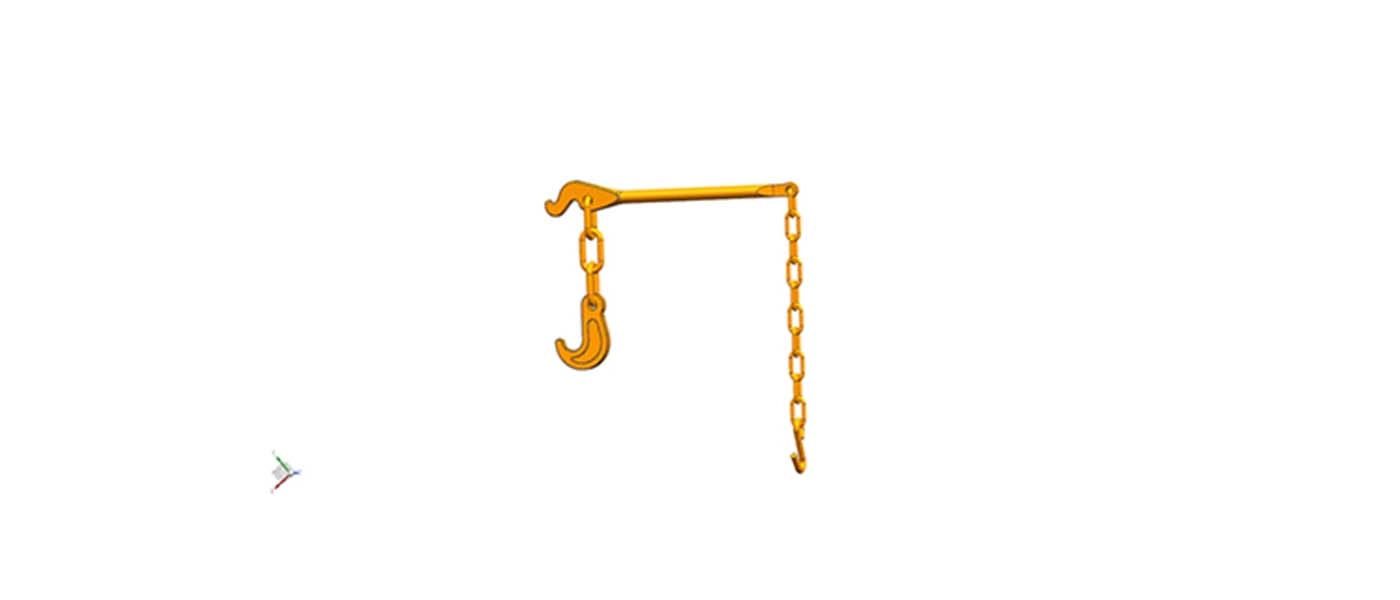
Why Does Transport Vibration Magnify Small Problems?
Road impacts, vehicle braking, vessel rolling, and structural vibration repeatedly act on the securing system.
Each individual vibration may be small, but continuous movement can gradually change the position of the chain links. The locking structure may also experience repeated impact. If the tensioner already has excessive clearance, uneven adjustment, or unreliable positioning, vibration can make these weaknesses appear more quickly.
When tension repeatedly decreases, the solution is not simply to tighten the mechanism again with greater force. The following areas should also be checked:
- Whether the locking section remains reliable
- Whether the adjustment mechanism shows wear
- Whether the pin and connection areas have abnormal clearance
- Whether the chain has shifted at the engagement point
- Whether the surface shows impact or rubbing marks
Only by identifying where movement is occurring can the same problem be prevented during the next transport cycle.
Tighter Does Not Always Mean More Secure
Excessive tightening is another commonly overlooked issue.
When too much tension is applied, the cargo support, vehicle structure, or deck securing point may carry unnecessary stress before transport even begins. Tires, brackets, or protective layers on some equipment may become compressed. As transport continues and this compression is released or the materials settle further, the chain may become loose again.
Excessive pre-tension may also cause:
- Local deformation around the securing point
- Concentrated contact between the chain link and tensioner
- Difficulty releasing the adjustment mechanism
- Damage to the cargo surface or supporting structure
- Premature fatigue and wear of components
The main value of a 9mm Lashing Chain Tensioner is not its ability to apply the greatest possible force. It is designed to help the securing system establish suitable, controlled, and repeatable tension.
Stable Securing Requires More Than the Chain Alone
When the cargo itself can move, the tensioner cannot solve every problem by itself.
Equipment with tires, movable arms, flexible supporting structures, and irregularly shaped cargo may change position during transport. In this situation, the chain may become loose even when the tensioner has not moved.
The securing arrangement may therefore need to include blocks, wheel chocks, supports, or other positioning methods according to the cargo condition. The tensioner controls chain tension, while stable support limits movement of the cargo itself. Reliable securing depends on both functions working together.
Inspection Before Reuse Should Cover More Than Corrosion
A 9mm Lashing Chain Tensioner may go through repeated cycles of installation, tightening, and removal. As the number of operating cycles increases, the condition of the load-bearing and moving sections becomes more important than surface appearance alone.
Inspection should focus on:
- Whether the body or pin is bent
- Whether the chain contact area has become noticeably thinner
- Whether openings or connection dimensions have changed
- Whether the adjustment remains smooth
- Whether moving parts have developed excessive clearance
- Whether cracks or deep surface damage are present
- Whether corrosion has affected locking or adjustment
If the mechanism becomes difficult to operate, it should not be forced by applying more power. Surface corrosion and internal wear may both change the loading condition and should be checked before the tensioner is used again.
How Does Manufacturing Accuracy Affect Tension Retention?
A 9mm Lashing Chain Tensioner contains both a load-bearing structure and an adjustable moving structure. Manufacturing should therefore focus on more than the strength of the main body.
The chain engagement area must be formed accurately. Pins and adjustment sections need suitable fit, while moving parts should operate smoothly without excessive looseness. Surface protection must also balance corrosion resistance with operating performance so that rust does not interfere with adjustment or locking.
Qingdao Wancheng Anchor Chain Co., Ltd. has extensive experience in manufacturing marine chains, mooring products, ship accessories, and related connection components. Products can be manufactured according to drawings and application requirements, with controlled dimensions, surface treatment, non-standard component processing, and product inspection.
Established in September 2006, the company has 269 employees and covers more than 90,000 square meters. Its marine anchor chain range covers diameters from Ø16mm to Ø122mm and includes Grade 2 and Grade 3 products. This chain manufacturing experience provides a solid production foundation for dimensional matching and consistent manufacturing of related components such as the 9mm Lashing Chain Tensioner.
Заключение
A chain becoming loose during transport is rarely caused by one factor alone. Cargo settlement, chain link repositioning, dimensional compatibility, installation direction, continuous vibration, structural wear, and excessive tightening can all change the original tension.
The role of a 9mm Lashing Chain Tensioner is to maintain controlled tension within the securing system, but it must work together with the correct chain dimensions, cargo condition, and connection direction.
Reliable tensioning is not simply about making the chain look tight before departure. It depends on whether the chain, tensioner, securing points, and cargo can maintain the correct relationship as transport conditions continue to change.
Часто задаваемые вопросы
Why is the chain tight at first but loose after some time in transport?
The cargo may continue to settle, protective materials may compress, and chain links may reposition. These changes can alter the effective working length of the chain.
Are all 9mm chains compatible with the same tensioner?
Not necessarily. In addition to nominal diameter, link length, internal width, shape, and engagement dimensions should also be confirmed.
Should a tensioner always be tightened as much as possible?
No. Excessive tightening may place unnecessary stress on the securing points and cargo structure. It may also create new slack if supporting materials later compress or settle.
When should a lashing chain tensioner be removed from use?
It should be removed from service when cracks, obvious deformation, severe corrosion, a jammed adjustment mechanism, unreliable locking, or serious wear in the contact area is found.

 Russian
 English
 Chinese
 Spanish
 Arabic
 Japanese
 Korean
 Portuguese