 Ir para o conteúdo

In the shipping and maritime industry, safety, stability, and operational efficiency are of utmost importance. One of the most critical components of a ship’s anchoring system is the cadeia de âncora. Many may wonder, what does an anchor chain do?
This article explores the essential functions, types, materials, and applications of anchor chains in maritime operations, helping ship operators, fleet managers, and maritime professionals understand why a high-quality anchor chain is indispensable.
The Primary Function of an corrente de ancoragem
An anchor chain is more than just a heavy steel chain connected to an anchor. Its main role is to secure a ship in a fixed position, preventing drifting due to currents, tides, or wind. The anchor chain transmits the holding power of the anchor to the seabed and absorbs the dynamic forces from waves and ship movement.
Unlike a rope or line, a chain provides weight and flexibility, allowing the anchor to dig deeper into the seabed and maintain a stable hold. The chain’s length, weight, and material directly influence the anchoring performance and safety of the ship.
Key Functions Include:
● Securing the Ship: O cadeia de âncora ensures the ship stays in position during port docking, offshore operations, or emergency anchoring.
● Absorbing Shock Loads: Waves, wind, and currents generate dynamic forces. The chain absorbs these shocks, reducing strain on both the anchor and the ship’s hull.
● Enhancing Anchor Holding Power: The weight of the chain helps the anchor lie flat on the seabed, improving its grip.
● Allowing Controlled Movement: The chain permits limited movement, which is critical to prevent sudden strain or damage in rough seas.
Components of an corrente de ancoragem System
An anchor chain system consists of several interconnected components that work together to secure a ship:
● Anchor: The part that embeds into the seabed to hold the vessel.
● Shackle: Connects the anchor to the chain.
● Anchor Chain (or Stud Link Chain): Transfers the load from the ship to the anchor.
● Chain Stopper / Roller Stopper: Locks the chain to prevent accidental release.
● Windlass: A mechanical device that raises or lowers the anchor and chain.
Each component must be carefully selected and maintained, as a failure in any part can compromise the entire anchoring operation.
Tipos de correntes de ancoragem
Anchor chains come in various types, depending on their application, material, and size. Understanding these types helps operators select the right chain for their vessels.
● Stud Link Chain: Features a crossbar (stud) in each link to prevent deformation and improve strength. Widely used on large ships and offshore platforms.
● Vantagens:
● Higher strength and durability
● Resistant to elongation and twisting
● Suitable for deep-sea and heavy-duty applications
● Studless Chain: Lighter and more flexible, suitable for smaller vessels or anchoring in shallow waters.
● Vantagens:
● Greater flexibility
● Lighter weight for easier handling
● Cost-effective for smaller ships
● Coating and Material Variations:
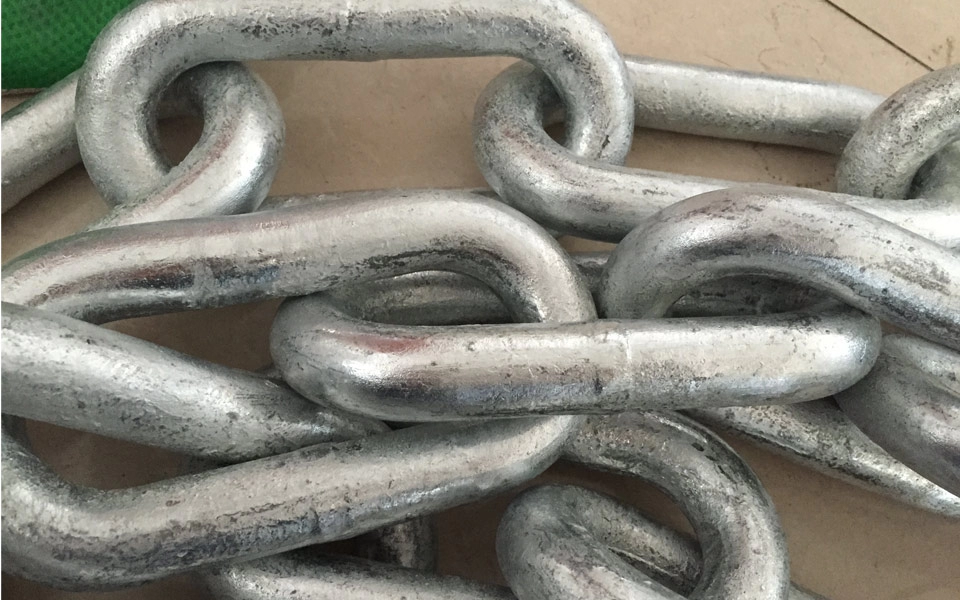
● Hot-Dip Galvanized Chains: Provide corrosion resistance for long-term seawater exposure.
● Alloy Steel Chains (G30, G43, G70, G80): High-strength options for heavy-duty and industrial maritime applications.
● Stainless Steel Chains: Resistant to corrosion and marine growth, ideal for high-end yachts or specialized ships.
Factors Affecting Anchor Chain Performance
Several factors influence how effectively an anchor chain performs:
● Chain Length: Sufficient scope (ratio of chain length to water depth) is essential to achieve optimal holding power.
● Chain Weight: Heavier chains lay flat and improve anchor grip.
● Water Conditions: Currents, waves, and seabed type affect chain selection.
● Maintenance: Regular inspection and lubrication prevent corrosion and wear.
Applications of Anchor Chains
Anchor chains are vital across various maritime operations:
● Commercial Shipping: Secure large cargo vessels in ports and offshore anchorage.
● Offshore Oil and Gas Platforms: Keep supply and support vessels stable during loading operations.
● Fishing Vessels: Anchor safely in open waters or fishing zones.
● Yachts and Leisure Boats: Ensure mooring security, even in adverse weather conditions.
● Deep-Sea Aquaculture: Maintain stability for floating fish farms and cages.
Maintenance and Safety Tips for Anchor Chains
Proper maintenance ensures anchor chains perform reliably and safely:
● Inspect chains regularly for corrosion, wear, or cracks.
● Replace damaged links immediately to avoid catastrophic failure.
● Lubricate pins and links to reduce friction and wear.
● Ensure proper storage and handling to prevent kinking or tangling.
● Select the right chain type and grade for the vessel’s size and operating environment.
Why High-Quality Anchor Chains Matter
Investing in high-quality anchor chains is not just about compliance—it is about safety and operational efficiency. Poor-quality chains can lead to:
● Anchor dragging or slipping
● Vessel drifting, collisions, or groundings
● Increased maintenance costs and downtime
● Risk to crew safety and cargo integrity
High-grade chains certified by international classification societies (ABS, LR, BV, DNV) provide confidence and reliability, especially for large commercial vessels and offshore operations.
Choose WAC for Reliable Anchor Chains
Qingdao Wancheng Anchor Chain Co., Ltd. (WAC), established in 2006, specializes in high-quality marine anchor chains and mooring equipment.
● Chains from 16mm to 122mm in diameter
● Certified by ABS, LR, and BV
● Widely used in shipbuilding, offshore platforms, and deep-sea aquaculture
Partnering with WAC ensures access to durable, certified anchor chains, technical expertise, and customized solutions to meet specific vessel requirements. Whether it’s standard stud link chains or high-strength alloy chains, WAC delivers safety, reliability, and operational efficiency.
Conclusão
So, what does an anchor chain do? An anchor chain secures ships, absorbs dynamic forces, enhances anchor holding power, and ensures maritime safety. Selecting the right type of chain, proper installation, and regular maintenance are essential to maximizing performance. Investing in high-quality anchor chains from trusted suppliers like WAC ensures both safety and operational efficiency, helping ships remain secure in all maritime conditions.
Perguntas frequentes
Q1: How long should an anchor chain be for safe anchoring?
The chain should have a scope of 5-7 times the water depth to ensure optimal holding power.
Q2: Can I use a studless chain for large cargo ships?
Studless chains are generally not recommended for large vessels due to lower strength and potential elongation under heavy loads.
Q3: How often should anchor chains be inspected?
Anchor chains should be inspected at least every 6 months or before and after long voyages, especially in saltwater environments.

 Portuguese
 English
 Chinese
 Spanish
 Arabic
 Japanese
 Korean
 Russian