
Uneven wear on Cadenas mineras does not necessarily mean that the chain itself lacks sufficient strength. Mining chains operate under a combination of tensile loading, impact, sprocket engagement and abrasive contact. Chain pitch, sprocket condition, conveyor alignment, scraper position and connector matching can all change where and how quickly wear develops.
For this reason, evaluating a mining chain should go beyond simply asking whether it is worn. More useful questions are: Where is the wear concentrated? Is the chain pitch changing? Does the chain still engage smoothly with the sprocket? Are both chain strands wearing at a similar rate?
These signs can help identify whether the problem originates primarily from the chain or whether the relationship between the chain and the conveyor system has already changed. They also reveal why dimensional consistency, sprocket compatibility and manufacturing stability matter in Mining Chains.
Why Does the Wear Pattern of Cadenas mineras Matter?
Cadenas mineras are not loaded uniformly at every point. Adjacent links articulate against each other, certain surfaces repeatedly contact the sprocket, and other areas interact with scrapers, connectors, coal, ore and abrasive particles.
Different wear locations can therefore provide different clues about operating conditions.
| Wear Pattern | Possible Cause | What to Check |
|---|---|---|
| Heavy wear between adjacent links | Abrasive contamination and repeated articulation | Interlink contact surfaces and conveyed material |
| Severe wear on one side of the link | Misalignment or side loading | Chain path and sprocket position |
| Faster wear at sprocket contact areas | Pitch change or poor engagement | Sprocket tooth profile and chain pitch |
| One chain strand wears faster | Unequal load distribution | Tension and alignment of both strands |
| Local wear near connectors | Dimensional interference or restricted movement | Connectors and scraper arrangement |
| Progressive increase in overall chain length | Accumulated contact wear | Chain elongation and sprocket compatibility |
The purpose of this table is not to diagnose a conveyor from one wear mark alone. Instead, the wear location can help narrow the inspection area.
For example, if one side of the links consistently shows heavy polishing or material loss, increasing chain strength is unlikely to solve the underlying problem. Conveyor alignment, sprocket position and scraper tracking may deserve more attention.
Why Does Mining Chain Elongation Change Sprocket Engagement?
Mining Chain Elongation is often described simply as the chain being “stretched.” During long-term operation, however, an increase in overall chain length can also result from progressive wear at interlink contact areas.
As material is gradually removed from these contact surfaces, the effective pitch of the chain changes. The difference at a single link may be small, but when it accumulates over dozens or hundreds of links, the original geometric relationship between the chain and sprocket can begin to change.
The process often develops in stages:
- Interlink contact surfaces gradually wear.
- Effective chain pitch increases.
- The seating position of the chain on the sprocket changes.
- A smaller number of sprocket teeth begin carrying more load.
- Local contact pressure becomes more concentrated.
- Wear on both the chain and sprocket accelerates.
This is why Mining Chain elongation should not be treated as an isolated length measurement.
When elongation begins increasing noticeably, it is also useful to check whether the links still enter the sprocket smoothly, whether lifting or jumping occurs during engagement, and whether contact remains evenly distributed across the sprocket teeth.
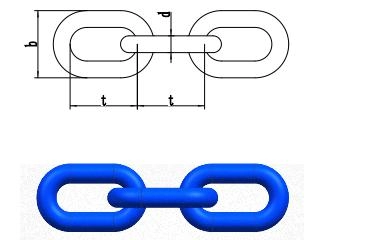
What Helps a Mining Chain Match a Conveyor System More Consistently?
Mining chain performance cannot be described by tensile strength alone. In continuous conveying equipment, long-term operating stability also depends on several dimensions and manufacturing characteristics that directly affect system compatibility.
Consistent Link Pitch
Pitch determines how regularly the chain engages with the sprocket. If pitch varies excessively between consecutive links, some links may contact the sprocket earlier than others and change the way load is distributed.
In long conveyor chains, even relatively small dimensional variations can accumulate and influence overall running behavior.
Internal Link Dimensions
The internal width and length of a link affect the installation and movement of connectors, scrapers and related components.
Dimensions that are too tight can restrict articulation, while excessive clearance can increase movement and impact. These dimensions therefore need to be considered together with the actual connection structure.
Chain Diameter and Load-Carrying Structure
Chain diameter determines the cross-sectional size of the link, but it should not be interpreted simply as “larger is better.” The important relationship is between chain diameter, pitch, sprocket dimensions and the operating load of the conveyor system.
Matching with Sprockets and Connectors
Mining Chains ultimately work together with sprockets, connectors and scrapers. Even if the chain dimensions themselves are correct, mismatched connecting components can still create local interference and additional wear.
For this reason, mining chain specifications are better confirmed as part of the complete conveyor arrangement rather than by selecting chain diameter alone.
Why Does Higher Strength Alone Not Determine Mining Chain Service Life?
Mining conditions can create the assumption that a harder or heavier chain will automatically last longer. In practice, Mining Chains must withstand tensile force, dynamic impact, abrasive material and continuous articulation at the same time.
Long-term performance therefore depends on a balance of several characteristics:
- Strength: supports the tensile forces generated during conveyor operation.
- Toughness: helps the chain withstand dynamic loads caused by start-up, material changes and impact.
- Wear resistance: slows material loss at interlink and sprocket contact areas.
- Dimensional consistency: helps maintain stable pitch and link geometry.
- Controlled heat treatment: supports an appropriate balance between strength, toughness and wear resistance.
- System compatibility: allows the chain to work correctly with sprockets, connectors and scrapers.
A suitable Mining Chain is therefore not defined by one exceptionally high specification. Material properties, chain geometry and equipment interfaces need to work together under the actual operating conditions.
How Should Premature Mining Chain Wear Be Inspected?
When Mining Chains reach an abnormal wear condition earlier than expected, inspecting only the most severely worn link may not reveal the full cause. A more useful approach is to examine the wear pattern, sprocket engagement and system condition in sequence.
1. Record the Wear Distribution
Determine whether wear is distributed relatively evenly along the chain or concentrated on particular links, one side of the chain or a specific contact surface.
Localized wear is often more informative than uniform wear because it can indicate alignment, interference or engagement problems.
2. Check Sprocket Engagement
Observe whether links enter the sprocket correctly and leave it smoothly. Lifting, jumping, impact or unusual noise can indicate that engagement has changed.
3. Compare Both Mining Chain Strands
In twin-chain conveyor systems, both strands should be evaluated together. If one strand elongates or wears noticeably faster, load distribution, tension and alignment should be checked.
4. Inspect Connectors and Scrapers
Look for abnormal rubbing, deformation, restricted movement or chain twisting around the connection areas. Changes in connector dimensions or position can alter the normal load path through the chain.
5. Review Actual Operating Conditions
If the conveyor configuration has not changed but chain wear suddenly accelerates, check whether conveyed material, loading level, moisture content, operating cycle or impact conditions have changed.
This approach shifts the question from “Which component failed first?” to “Which operating condition caused the wear rate to increase?”
Wancheng Mining Chains Manufacturing and System-Matching Support
Qingdao Wancheng Anchor Chain Co., Ltd. can support Cadenas mineras according to chain diameter, pitch, link dimensions and conveyor interface requirements, including drawing-based production, dimensional matching, non-standard chain configurations and related connecting components.
Its long-term heavy-chain manufacturing experience covers link forming, heat treatment, dimensional inspection and coordination with associated chain components. Where standard dimensions cannot directly match existing sprockets, scrapers or connection structures, chain dimensions can be evaluated against drawings and actual equipment requirements to achieve more suitable integration with the conveyor system.
Conclusión
The service life of Cadenas mineras cannot be determined by tensile strength alone.When investigating premature wear, three relationships are particularly useful:Wear location + Pitch change + Sprocket engagement
Wear between adjacent links often reflects articulation and abrasive contact. One-sided wear deserves closer attention to conveyor alignment. Abnormal wear around the sprocket may indicate that chain pitch and engagement geometry have already changed. At the same time, dimensional consistency, heat-treatment condition and compatibility with sprockets and connectors also influence long-term performance.
Evaluating Mining Chains as part of the complete conveyor system makes it easier to identify the real causes of premature wear and highlights the importance of dimensional control, system matching and manufacturing consistency in heavy-duty chain applications.
Preguntas más frecuentes
Why do Mining Chains develop wear on only one side?
One-sided wear can indicate problems with chain tracking, sprocket position, conveyor alignment or continuous side loading. If the source of the problem is system misalignment, replacing the chain alone may not eliminate the abnormal contact.
Does Mining Chain Elongation always mean the chain steel has stretched?
No. Progressive wear at interlink contact areas can also increase the effective pitch and appear as an increase in overall chain length.
Why should the sprocket be checked when replacing Mining Chains?
A sprocket can gradually develop a worn tooth profile while operating with an old chain. If that geometry no longer matches the pitch of the new chain, abnormal engagement and localized wear may develop quickly.
Which dimensions matter most when matching Mining Chains?
In addition to chain diameter, link pitch, internal link width, connector dimensions, sprocket geometry and scraper arrangement should also be considered. For existing conveyor equipment, complete interface compatibility is often more important than chain diameter alone.

 Spanish
 English
 Chinese
 Arabic
 Japanese
 Korean
 Russian
 Portuguese