
An Grillete de anclaje M2/M3 11mm-120mm is a relatively small component compared with an anchor or a full length of anchor chain, yet it sits directly in the load path between major parts of the anchoring system. Wancheng lists this product within its ship-accessory range in sizes from 11mm to 120mm.
The most common mistake is to treat chain diameter as the only matching condition. If the chain is 40mm, it may seem reasonable to choose a shackle described for the corresponding nominal size. In practice, however, link opening, shackle bow clearance, pin diameter, connected anchor geometry, and available articulation space all affect whether the connection can move and carry load as intended.
For this reason, a correct anchor-shackle connection is better evaluated as a geometry problem, not simply a diameter problem.
Grillete de anclaje M2/M3 11mm-120mm: Which Dimensions Actually Need to Match?
El Grillete de anclaje M2/M3 11mm-120mm series covers multiple nominal chain sizes, but each shackle has to fit both sides of the connection. One side may interact with an anchor end or enlarged link, while the pin passes through another connecting component.
A practical dimensional check should consider:
- nominal anchor-chain diameter;
- internal width of the connected link;
- shackle bow dimensions;
- pin diameter and length;
- clearance around the connection;
- available rotational movement;
- anchor-side connection geometry.
The objective is not to create the tightest possible connection. A marine chain connection needs enough clearance to articulate as the anchor is deployed, set, recovered, and drawn toward the vessel.
At the same time, excessive clearance can allow components to move into less favorable contact positions.
Why Is Chain Diameter Alone Not Enough?
Nominal diameter tells you the basic size class of an anchor chain, but it does not describe the complete shape of the link.
Two chain systems with similar nominal diameters can still differ in:
- link length;
- internal width;
- end-link dimensions;
- connecting-shackle arrangement;
- component tolerances.
This becomes particularly important near the end of an anchor chain, where standard links may transition into enlarged links, end links, swivels, or other fittings.
The shackle therefore needs to match the actual interface, not simply the diameter printed in the chain specification.
A useful rule is:Chain diameter identifies the size range; interface dimensions confirm the connection.
What Can the Contact Pattern Tell You About a Poor Shackle Match?
An anchor shackle that is dimensionally unsuitable does not always show an obvious problem immediately. In many cases, the first signs appear as concentrated contact or uneven wear.
| Observation | What It May Indicate | What to Check |
|---|---|---|
| Wear concentrated on one side of the bow | Connection is not aligning naturally | Link position and articulation |
| Pin shows uneven contact | Load is entering the pin off-center | Pin fit and connected-link width |
| Link touches the shackle body during movement | Clearance is insufficient | Bow opening and link dimensions |
| Connection becomes difficult to rotate | Components are binding | Interface geometry and deformation |
| Local polishing develops quickly | Repeated contact at one point | Alignment and available movement |
These marks should not be treated as a diagnosis by themselves. They are more useful as evidence showing where the connection is actually carrying contact.
That information can reveal whether the shackle is working through its intended geometry or whether another component is forcing it into an unfavorable position.
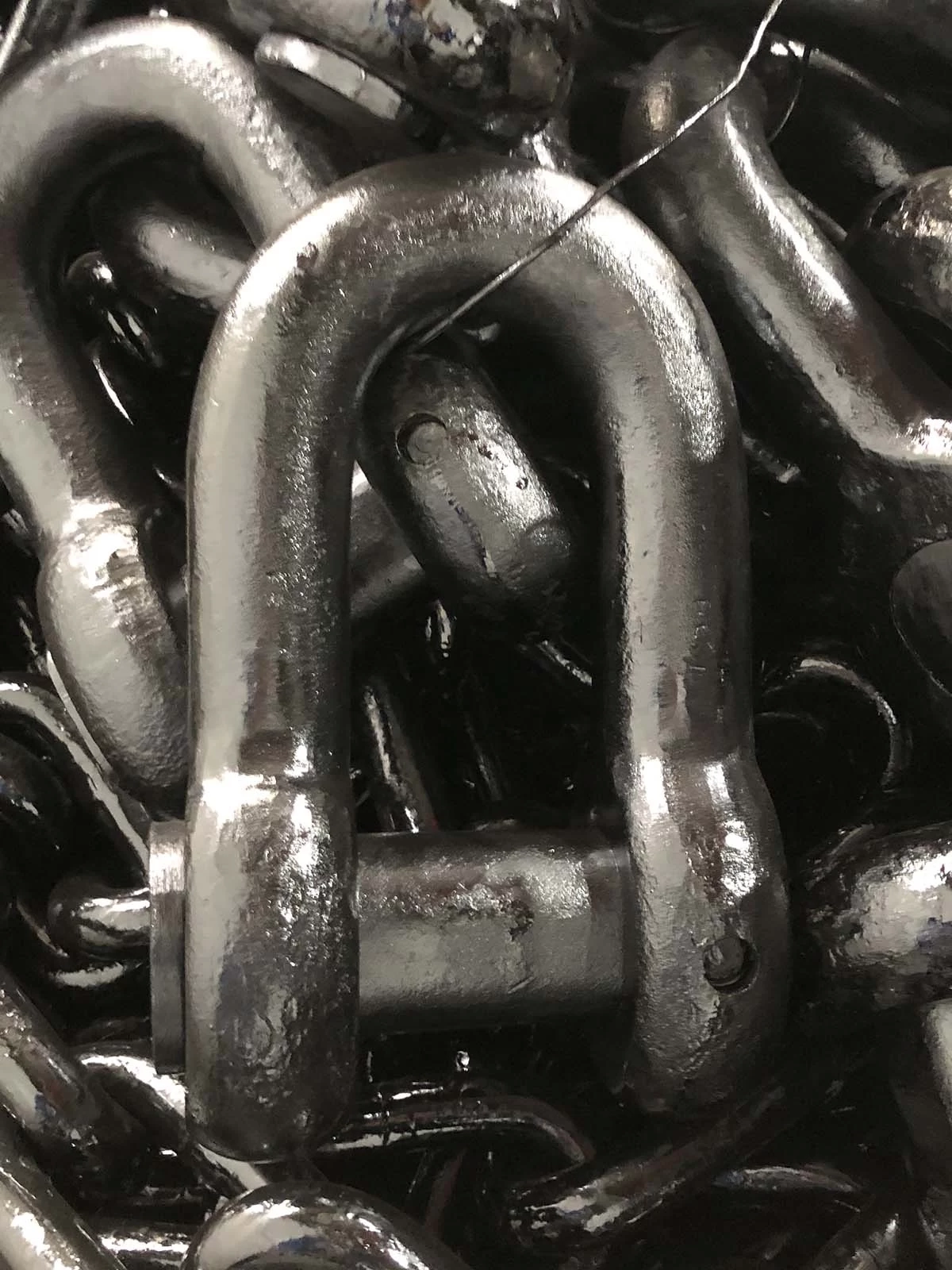
Why Does Articulation Matter in an Anchor Connection?
An anchoring system is not static. The anchor changes orientation during deployment and recovery, while the chain moves through different angles as vessel position and load direction change.
A shackle connection therefore needs to allow controlled articulation.
If movement is restricted, the connection may begin transferring force through edges or side-contact areas instead of allowing components to align with the load. This is particularly important around anchor-side connections because the anchor itself can rotate relative to the chain.
The shackle does not need unlimited movement, but it should have enough freedom for the intended configuration.
This is why three questions are useful during matching:
- Can the connected link move without contacting the wrong part of the shackle?
- Can the shackle align naturally with the chain under load?
- Does the connection retain enough clearance through the expected operating angle?
If the answer to one of these is no, nominal size matching alone is not sufficient.
M2 and M3: Why Does the Chain Grade Matter Together with the Shackle?
The M2/M3 designation is important because the shackle is part of a chain system, not an independent piece of hardware. Its mechanical requirements need to correspond with the intended anchor-chain grade and project requirements.
In practice, chain grade affects how the complete system is specified and verified. The shackle, joining components, swivel arrangements, and chain should therefore be considered together instead of mixing components only because their physical dimensions appear similar.
This is particularly useful when reviewing:
- replacement anchor-chain assemblies;
- vessel repair projects;
- new anchor-chain configurations;
- end-link and shackle combinations;
- anchor-to-chain connection systems.
A physically fitting component is not automatically a correctly matched system component.
Why Are Replacement Projects More Difficult?
Replacement work is often more complicated than newbuilding because the surrounding equipment is already fixed.
A vessel may retain the existing:
- anchor;
- anchor chain;
- end link;
- swivel or swivel forerunner;
- hawse arrangement.
If only the anchor shackle is being replaced, the new component must fit the existing geometry rather than an idealized new system.
For this reason, replacement confirmation is easier when the following information is available:
- existing shackle dimensions;
- chain diameter and grade;
- end-link or anchor connection dimensions;
- original drawing, where available;
- photographs of the existing arrangement;
- required project or classification documentation.
This can prevent a situation where the nominal diameter is correct but the pin, bow, or available clearance does not match the existing assembly.
When Should a Drawing Be Used Instead of Only a Product Size?
A product size is usually enough to identify the general range, but a drawing becomes much more useful when the connection is non-standard, existing equipment must be retained, or several fittings meet in a confined space.
A drawing can answer questions that “40mm shackle” cannot:
- What is the internal bow clearance?
- What is the pin diameter?
- How wide is the connected end link?
- How much rotation is available?
- Will the shackle interfere with the anchor or adjacent fitting?
This is especially important in marine chain systems because dimensional relationships continue from one component to the next.
One incorrectly matched interface can affect how the entire connection aligns.
What Should Be Checked Before the Anchor Shackle Returns to Service?
Inspection should focus on both the condition of the shackle and the way it interacts with nearby components.
Useful checks include:
Bow condition
Look for localized wear, deformation, or unusual contact marks.
Pin condition
Confirm that the pin remains correctly seated and does not show abnormal one-sided contact.
Connected links
Check whether the link can move naturally without binding against the shackle body.
Alignment
Observe whether the chain and shackle settle into a natural load path rather than remaining visibly twisted.
Corrosion and surface condition
Marine exposure can affect both visible surfaces and moving interfaces, so surface condition should be considered together with dimensional wear.
The key question is not simply whether the shackle still looks complete, but whether the complete connection still moves and aligns correctly.
Wancheng’s Supply Support for Anchor Shackles and Anchor Chain Systems
Qingdao Wancheng Anchor Chain Co., Ltd. supplies Grillete de anclaje M2/M3 11mm-120mm together with marine anchor chains and related ship accessories. Its ship-accessory range also includes joining shackles, Kenter shackles, swivels, swivel forerunners, and swivel shackles, allowing multiple interfaces in an anchor-chain system to be considered together.
For newbuilding and replacement requirements, Wancheng can support dimensional confirmation, drawing-based matching, anchor-chain coordination, and related technical documentation. This is particularly useful when the shackle needs to match an existing anchor, end link, swivel arrangement, or chain system rather than being supplied as an isolated component.
Conclusión
An Grillete de anclaje M2/M3 11mm-120mm should not be confirmed by nominal chain diameter alone.
The more useful matching relationship is:
Chain size + Link dimensions + Shackle clearance + Pin fit + Articulation
When these elements are coordinated, the shackle can remain properly aligned between the anchor and chain system while allowing the movement required during deployment and recovery.
For both newbuilding and replacement projects, checking the complete connection geometry is more reliable than assuming that the same nominal diameter automatically means the same fit.
Preguntas más frecuentes
What size range does Wancheng’s Anchor Shackle M2/M3 cover?
Wancheng lists the Anchor Shackle M2/M3 product in a nominal size range of 11mm-120mm.
Is chain diameter enough to determine the correct anchor shackle?
No. Chain diameter identifies the basic size range, but pin dimensions, link width, bow clearance, grade, and the actual connection arrangement should also be checked.
Why does an anchor shackle need articulation space?
The anchor and chain change orientation during deployment and recovery. Adequate articulation allows connected components to align more naturally with the load instead of binding against each other.
Can Wancheng supply related anchor-chain connection components?
Yes. Wancheng’s ship-accessory range includes Anchor Shackles, Joining Shackles, Kenter Shackles, Swivel Forerunners, Swivels, and Swivel Shackles.

 Spanish
 English
 Chinese
 Arabic
 Japanese
 Korean
 Russian
 Portuguese