 saltar al contenido

A mooring line rarely stays in one perfectly straight direction. As a vessel approaches a berth, shifts with wind and current, or changes position under load, the line angle between the deck and shore connection can also change. Without a suitable guiding point, the rope or wire may rub against a fixed edge, bend sharply, or repeatedly contact the same surface.
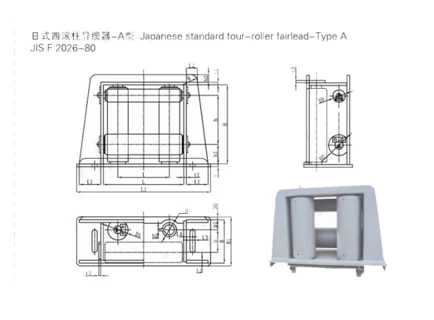
El Guiacabos de cuatro rodillos estándar japonés tipo A 140-315 is designed to guide the mooring line through these changing directions. Instead of forcing the line around a fixed steel surface, the roller arrangement provides moving contact points that allow the line to change direction more smoothly.
For this reason, the real value of a four-roller fairlead is not simply that it has four rollers. What matters is how the roller arrangement, nominal size, rope path, deck position, and surrounding mooring equipment work together.
Guiacabos de cuatro rodillos estándar japonés tipo A 140-315: Why Does Rope Direction Matter?
El Guiacabos de cuatro rodillos estándar japonés tipo A 140-315 works at a point where the direction of a mooring line changes. That makes the actual lead angle one of the most important conditions affecting its operation.
When a line approaches a fairlead at an angle, the load does not always remain on the same roller. As the vessel moves, the contact position may shift between horizontal and vertical rolling surfaces. A suitable roller arrangement allows this directional change without repeatedly pulling the line across a stationary edge.
This becomes particularly important when:
- the shore connection is not directly in line with the deck equipment;
- the vessel moves relative to the berth;
- the rope lead changes during mooring operations;
- the line needs to pass from deck equipment toward a lower or side position;
- different mooring arrangements use the same deck area.
The fairlead therefore acts as a controlled transition between two different rope directions.
Why Are Four Rollers Useful Instead of One?
A single roller can guide a rope effectively when the direction of movement is relatively predictable. Mooring arrangements, however, often involve both horizontal and vertical changes in the rope path.
A four-roller configuration creates more than one rolling contact surface around the opening. When the rope direction moves sideways or vertically, it can transfer contact from one roller to another instead of pressing against a fixed frame edge.
This can help reduce several common problems:
Localized abrasion.
Repeated contact with a fixed edge can concentrate wear on one section of the rope. A rotating roller allows the contact surface to move with the line.
Sharp directional change.
A rope forced around a small or fixed contact point experiences a more severe bend. The roller provides a controlled surface for changing direction.
Unstable rope tracking.
When the lead angle changes, a properly positioned set of rollers helps keep the line within the intended guiding area.
The rollers do not remove tension from the mooring line. Their role is to manage how the loaded line changes direction.
What Does the 140-315 Size Range Actually Affect?
The 140-315 range should not be treated simply as a progression from “small” to “large.” Changing the nominal size affects the physical relationship between the fairlead and the mooring line.
A larger fairlead generally provides different roller dimensions, opening space, frame dimensions, and overall installation requirements. The correct size therefore needs to suit both the line and the available deck arrangement.
Several factors should be considered together:
| Selection Factor | Why It Matters |
|---|---|
| Mooring line diameter | Determines how the line contacts the rollers |
| Roller dimensions | Affect the bending path around the fairlead |
| Fairlead opening | Needs sufficient space for the intended rope movement |
| Lead angle | Determines which rollers receive contact |
| Deck space | Influences installation and surrounding clearance |
| Mooring equipment position | Defines the actual rope path |
This is why simply installing a larger fairlead does not automatically improve the mooring arrangement. If its position or proportions do not match the rope path, the line may still contact the rollers incorrectly.

What Happens When the Fairlead Does Not Match the Rope Path?
One of the easiest ways to understand fairlead performance is to look at the wear marks after operation.
If a mooring line consistently contacts only the edge of one roller, the lead direction may not be well centered. If the line repeatedly touches part of the frame rather than the roller surface, the deck position or fairlead size may need to be reviewed.
Several operating signs deserve attention:
- uneven wear on one roller;
- rope contact marks on the frame;
- one roller carrying most of the line contact;
- line movement accompanied by excessive friction;
- rollers that do not rotate freely under movement;
- repeated rope wear appearing at the same location.
These conditions do not automatically mean the fairlead itself is defective. They may reveal a mismatch between the fairlead position and the real rope lead.
This is why inspecting the contact pattern can often provide more useful information than simply inspecting the fairlead for visible damage.
Fairlead Position Can Matter as Much as Fairlead Size
Even a correctly sized Japanese Standard Four-Roller Fairlead may not perform as intended if it is installed in the wrong position.
A fairlead works between the mooring line outside the vessel and deck equipment such as a winch, bollard, or other rope-handling arrangement. Its location determines how the line approaches the rollers and how it leaves them.
During layout confirmation, useful questions include:
- Where does the line come from?
- Where does it go after leaving the fairlead?
- What is the expected horizontal lead angle?
- How much vertical angle is expected?
- Will the line direction change during operation?
- Is there enough clearance around the frame and rollers?
These questions make the fairlead part of the complete mooring line path, rather than an isolated deck fitting.
What Should Be Inspected During Service?
Roller fairleads operate under repeated rope contact, so inspection should focus on both movement and contact surfaces.
A practical inspection can include:
Roller Rotation
Each roller should remain capable of normal rotation. Restricted movement changes a rolling contact into sliding contact, increasing friction on the line.
Roller Surface
Grooves, severe local wear, rough areas, or damaged surfaces can change how the rope travels over the roller.
Pins and Moving Areas
The roller needs to remain correctly positioned around its supporting structure. Excessive movement or restricted rotation deserves attention.
Frame Condition
The frame should be checked for unusual contact marks, deformation, corrosion, or areas where the rope has been rubbing outside the intended roller surfaces.
Rope Contact Pattern
Where the rope actually touches the fairlead can reveal whether the equipment remains correctly aligned with the working lead angle.
These checks help connect the condition of the fairlead with the condition of the complete mooring arrangement.
Why Is Surface Condition Important in Marine Service?
A roller fairlead remains exposed on deck, where moisture, salt, repeated rope contact, and weather can affect its surface over time.
Surface protection helps reduce environmental deterioration, but it also needs to work together with routine inspection. Roller surfaces should remain sufficiently smooth so that they do not introduce unnecessary abrasion to the mooring line.
The important point is not simply whether a coating is present. The complete fairlead needs a combination of:
- stable roller surfaces;
- controlled dimensions;
- free roller movement;
- suitable marine surface protection;
- consistent frame geometry.
These factors directly affect how the line interacts with the fairlead during repeated mooring operations.
Wancheng’s Supply Support for Marine Fairleads and Deck Equipment
Qingdao Wancheng Anchor Chain Co., Ltd. can supply Guiacabos de cuatro rodillos estándar japonés tipo A 140-315 together with other marine deck and mooring components, including chocks, bollards, chain stoppers, anchors, anchor chains, and related ship accessories.
For different vessel and shipyard requirements, Wancheng can support dimensional confirmation, drawing-based requirements, product matching, and related technical documentation. With more than 90,000 m² of production space and long-term experience in marine chains and ship equipment, the company can coordinate individual deck fittings with the wider mooring and anchoring arrangement rather than treating each component separately.
Conclusión
The purpose of a Guiacabos de cuatro rodillos estándar japonés tipo A 140-315 is not simply to provide a passage for a mooring line. Its real function is to control how a loaded line changes direction between the vessel and the external mooring point.
For stable operation, four relationships matter most:
Rope size + Lead angle + Roller contact + Deck position
When these factors are properly coordinated, the rollers can guide the line through changing directions while reducing unnecessary edge contact and concentrated abrasion. This makes fairlead selection and positioning part of the complete mooring-system design rather than a decision based only on nominal size.
Preguntas más frecuentes
What is a Japanese Standard Four-Roller Fairlead-Type A 140-315 used for?
It is used to guide mooring lines as their direction changes between deck equipment and the external mooring point, providing rolling contact instead of allowing the line to rub directly against fixed edges.
Why does a four-roller fairlead use multiple rollers?
Multiple rollers allow the line to be guided when its lead direction changes horizontally or vertically, helping maintain controlled contact as the vessel moves.
Is a larger roller fairlead always better?
No. Fairlead size should match the mooring line, expected lead angles, deck layout, and surrounding equipment. A larger size does not correct an unsuitable installation position.
What should be checked when a mooring line wears rapidly near the fairlead?
Check the actual rope contact pattern, roller rotation, roller surface condition, fairlead alignment, and whether the line is contacting the frame instead of the intended roller surfaces.

 Spanish
 English
 Chinese
 Arabic
 Japanese
 Korean
 Russian
 Portuguese